Sunday, 14 February 2016

SDLC - Agile Model

Agile SDLC model is a combination of iterative and incremental process models with focus on process adaptability and customer satisfaction by rapid delivery of working software product.
Agile Methods break the product into small incremental builds. These builds are provided in iterations. Each iteration typically lasts from about one to three weeks. Every iteration involves cross functional teams working simultaneously on various areas like planning, requirements analysis, design, coding, unit testing, and acceptance testing.
At the end of the iteration a working product is displayed to the customer and important stakeholders.

What is Agile?

Agile model believes that every project needs to be handled differently and the existing methods need to be tailored to best suit the project requirements. In agile the tasks are divided to time boxes (small time frames) to deliver specific features for a release.
Iterative approach is taken and working software build is delivered after each iteration. Each build is incremental in terms of features; the final build holds all the features required by the customer.
Here is a graphical illustration of the Agile Model:
SDLC Agile Model
Agile thought process had started early in the software development and started becoming popular with time due to its flexibility and adaptability.
The most popular agile methods include Rational Unified Process (1994), Scrum (1995), Crystal Clear, Extreme Programming (1996), Adaptive Software Development, Feature Driven Development, and Dynamic Systems Development Method (DSDM) (1995). These are now collectively referred to as agile methodologies, after the Agile Manifesto was published in 2001.
Following are the Agile Manifesto principles
  • Individuals and interactions - in agile development, self-organization and motivation are important, as are interactions like co-location and pair programming.
  • Working software - Demo working software is considered the best means of communication with the customer to understand their requirement, instead of just depending on documentation.
  • Customer collaboration - As the requirements cannot be gathered completely in the beginning of the project due to various factors, continuous customer interaction is very important to get proper product requirements.
  • Responding to change - agile development is focused on quick responses to change and continuous development.

Agile Vs Traditional SDLC Models

Agile is based on the adaptive software development methods where as the traditional SDLC models like waterfall model is based on predictive approach.
Predictive teams in the traditional SDLC models usually work with detailed planning and have a complete forecast of the exact tasks and features to be delivered in the next few months or during the product life cycle. Predictive methods entirely depend on the requirement analysis and planning done in the beginning of cycle. Any changes to be incorporated go through a strict change control management and prioritization.
Agile uses adaptive approach where there is no detailed planning and there is clarity on future tasks only in respect of what features need to be developed. There is feature driven development and the team adapts to the changing product requirements dynamically. The product is tested very frequently, through the release iterations, minimizing the risk of any major failures in future.
Customer interaction is the backbone of Agile methodology, and open communication with minimum documentation are the typical features of Agile development environment. The agile teams work in close collaboration with each other and are most often located in the same geographical location.

Agile Model Pros and Cons

Agile methods are being widely accepted in the software world recently, however, this method may not always be suitable for all products. Here are some pros and cons of the agile model.
Following table lists out the pros and cons of Agile Model:
ProsCons
  • Is a very realistic approach to software development
  • Promotes teamwork and cross training.
  • Functionality can be developed rapidly and demonstrated.
  • Resource requirements are minimum.
  • Suitable for fixed or changing requirements
  • Delivers early partial working solutions.
  • Good model for environments that change steadily.
  • Minimal rules, documentation easily employed.
  • Enables concurrent development and delivery within an overall planned context.
  • Little or no planning required
  • Easy to manage
  • Gives flexibility to developers
  • Not suitable for handling complex dependencies.
  • More risk of sustainability, maintainability and extensibility.
  • An overall plan, an agile leader and agile PM practice is a must without which it will not work.
  • Strict delivery management dictates the scope, functionality to be delivered, and adjustments to meet the deadlines.
  • Depends heavily on customer interaction, so if customer is not clear, team can be driven in the wrong direction.
  • There is very high individual dependency, since there is minimum documentation generated.
  • Transfer of technology to new team members may be quite challenging due to lack of documentation.

What is Agile model – advantages, disadvantages and when to use it?

Agile development model is also a type of Incremental model. Software is developed in incremental, rapid cycles. This results in small incremental releases with each release building on previous functionality. Each release is thoroughly tested to ensuresoftware quality is maintained. It is used for time critical applications.  Extreme Programming (XP) is currently one of the most well known agile development life cycle model.

Agile model in Software testing
Advantages of Agile model:
  • Customer satisfaction by rapid, continuous delivery of useful software.
  • People and interactions are emphasized rather than process and tools. Customers, developers and testers constantly interact with each other.
  • Working software is delivered frequently (weeks rather than months).
  • Face-to-face conversation is the best form of communication.
  • Close, daily cooperation between business people and developers.
  • Continuous attention to technical excellence and good design.
  • Regular adaptation to changing circumstances.
  • Even late changes in requirements are welcomed
Disadvantages of Agile model:
  • In case of some software deliverables, especially the large ones, it is difficult to assess the effort required at the beginning of the software development life cycle.
  • There is lack of emphasis on necessary designing and documentation.
  • The project can easily get taken off track if the customer representative is not clear what final outcome that they want.
  • Only senior programmers are capable of taking the kind of decisions required during the development process. Hence it has no place for newbie programmers, unless combined with experienced resources.
When to use Agile model:
  • When new changes are needed to be implemented. The freedom agile gives to change is very important. New changes can be implemented at very little cost because of the frequency of new increments that are produced.
  • To implement a new feature the developers need to lose only the work of a few days, or even only hours, to roll back and implement it.
  • Unlike the waterfall model in agile model very limited planning is required to get started with the project. Agile assumes that the end users’ needs are ever changing in a dynamic business and IT world. Changes can be discussed and features can be newly effected or removed based on feedback. This effectively gives the customer the finished system they want or need.
  • Both system developers and stakeholders alike, find they also get more freedom of time and options than if the software was developed in a more rigid sequential way. Having options gives them the ability to leave important decisions until more or better data or even entire hosting programs are available; meaning the project can continue to move forward without fear of reaching a sudden standstill.

Agile Methodology

What Is Agile?

Agile methodology is an alternative to traditional project management, typically used in software development. It helps teams respond to unpredictability through incremental, iterative work cadences, known as sprints. Agile methodologies are an alternative to waterfall, or traditional sequential development.

What is Scrum?

Scrum is the most popular way of introducing Agility due to its simplicity and flexibility. Because of this popularity, many organizations claim to be “doing Scrum” but aren’t doing anything close to Scrum’s actual definition. Scrum emphasizes empirical feedback, team self management, and striving to build properly tested product increments within short iterations. Doing Scrum as it’s actually defined usually comes into conflict with existing habits at established non-Agile organizations.
Scrum has only three roles: Product Owner, Team, and Scrum Master. These are described in detail by the Scrum Training Series. The responsibilities of the traditional project manager role are split up among these three Scrum roles. Scrum has five meetings: Backlog Grooming (aka Backlog Refinement), Sprint Planning, Daily Scrum (aka 15-minute standup), the Sprint Review Meeting, and the Sprint Retrospective Meeting.
Many books and classes are available from a variety of competing sources of varying accuracy and quality.  One place to start would be the Scrum Training Series, which uses an entertaining approach to cover the most popular way of introducing Agile to teams. You can also download the 6-page illustrated Scrum Reference Card.

Where Did Agile Come From?

In 1970, Dr. Winston Royce presented a paper entitled “Managing the Development of Large Software Systems,” which criticized sequential development. He asserted that software should not be developed like an automobile on an assembly line, in which each piece is added in sequential phases. In such sequential phases, every phase of the project must be completed before the next phase can begin. Dr. Royce recommended against the phase based approach in which developers first gather all of a project’s requirements, then complete all of its architecture and design, then write all of the code, and so on. Royce specifically objected to this approach due to the lack of communication between the specialized groups that complete each phase of work.
It’s easy to see how the “waterfall” methodology is far from optimized compared to agile methodology. First of all, it assumes that every requirement of the project can be identified before any design or coding occurs. Put another way, do you think you could tell a team of developers everything that needed to be in a piece of software before it was up and running? Or would it be easier to describe your vision to the team if you could react to functional software? Many software developers have learned the answer to that question the hard way: At the end of a project, a team might have built the software it was asked to build, but, in the time it took to create, business realities have changed so dramatically that the product is irrelevant. In that scenario, a company has spent time and money to create software that no one wants. Couldn’t it have been possible to ensure the end product would still be relevant before it was actually finished?

Why Agile?

Agile development methodology provides opportunities to assess the direction of a project throughout the development lifecycle. This is achieved through regular cadences of work, known as sprints or iterations, at the end of which teams must present a potentially shippable product increment. By focusing on the repetition of abbreviated work cycles as well as the functional product they yield, agile methodology is described as “iterative” and “incremental.” In waterfall, development teams only have one chance to get each aspect of a project right. In an agile paradigm, every aspect of development — requirements, design, etc. — is continually revisited throughout the lifecycle. When a team stops and re-evaluates the direction of a project every two weeks, there’s always time to steer it in another direction.
The results of this “inspect-and-adapt” approach to development greatly reduce both development costs and time to market. Because teams can develop software at the same time they’re gathering requirements, the phenomenon known as “analysis paralysis” is less likely to impede a team from making progress. And because a team’s work cycle is limited to two weeks, it gives stakeholders recurring opportunities to calibrate releases for success in the real world. Agile development methodology helps companies build the right product. Instead of committing to market a piece of software that hasn’t even been written yet, agile empowers teams to continuously replan their release to optimize its value throughout development, allowing them to be as competitive as possible in the marketplace. Development using an agile methodology preserves a product’s critical market relevance and ensures a team’s work doesn’t wind up on a shelf, never released.

Wednesday, 10 February 2016

What is Regression testing in software?

Regression testing: During confirmation testing the defect got fixed and that part of the application started working as intended. But there might be a possibility that the fix may have introduced or uncovered a different defect elsewhere in the software. The way to detect these ‘unexpected side-effects’ of fixes is to do regression testing. The purpose of a regression testing is to verify that modifications in the software or the environment have not caused any unintended adverse side effects and that the system still meets its requirements. Regression testing are mostly automated because in order to fix the defect the same test is carried out again and again and it will be very tedious to do it manually. Regression tests are executed whenever the software changes, either as a result of fixes or new or changed functionality.

The purpose of regression testing is to confirm that a  recent program or code change has not adversely affected existing features.
Regression testing is nothing but full or partial selection of already executed test cases which are re-executed to ensure existing functionalities work fine.
This testing is done to make sure that new code changes should not have side effects on the existing functionalities. It  ensures that old code still works once  the new code changes are done.

Need of Regression Testing

  
Regression Testing is required when there is a
  • Change in requirements and code is modified according to the requirement
  • New feature is added to the software
  • Defect fixing
  • Performance issue fix 

Regression Testing Techniques

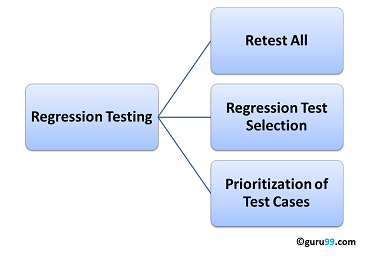
Software maintenance is an activity which includes enhancements, error corrections, optimization and deletion of existing features. These modifications may cause the system to work incorrectly . Therefore , Regression Testing becomes necessary. Regression Testing can be carried out using following techniques:
regression testing types
                              

Retest All

  • This is one of the methods for regression testing in which all the tests in the existing test bucket or suite should be re-executed. This is very expensive as it requires huge time and resources.

Regression Test Selection

  • Instead of re-executing the entire test suite, it is better to select part of test suite to be run
  • Test cases selected can be categorized as 1) Reusable Test Cases 2) Obsolete Test Cases.
  • Re-usable Test cases can be used in succeeding regression cycles.
  • Obsolete Test Cases can't be used in succeeding cycles.

Prioritization of Test Cases

  • Prioritize the test cases depending on business impact, critical &  frequently used functionalities . Selection of test cases based on priority will greatly reduce the regression test suite.

Selecting test cases for regression testing

It was found from industry data that good number of the defects reported by customers were due to last minute bug fixes creating side effects and hence selecting the test case for regression testing is an art and not that easy.  Effective Regression Tests can be done by selecting following test cases -
  • Test cases which have frequent defects
  • Functionalities which are more visible to the users
  • Test cases which verify core features of the product
  • Test cases of Functionalities which has undergone more and recent changes
  • All Integration Test Cases
  • All Complex Test Cases
  • Boundary value test cases
  • Sample of Successful test cases
  • Sample of Failure test cases

Regression Testing Tools


If your software undergoes frequent changes , regression testing costs will escalate.
In such cases , Manual execution of test cases increases test execution time as well as  costs.
Automation of regression test cases is the smart choice in such cases.  
Extent of automation depends on the number of test cases that remain re-usable for successive regression cycles. 

Following are most important tools used for both functional and regression testing:
Quick Test Professional (QTP):HP Quick Test Professional is automated software designed to automate functional and regression test cases. It uses VbScript language for automation. It is a Data driven , Keyword based tool. 
Rational Functional Tester (RFT):IBM's rational functional tester is a java tool used to automate the test cases of software applications. This is primarily used for automating regression test cases and it also integrates with Rational Test Manager. 
Selenium:This is an open source tool used for automating web applications. Selenium can be used for browser based regression testing.

Regression Testing and Configuration Management

Configuration Management during Regression Testing becomes imperative in Agile Environments where code is being continuously modified. To ensure effective regression tests , observe the following :
  • Code being regression tested should be under a configuration management tool
  • No changes must be allowed to code , during the regression test phase.  Regression test code must be kept immune to developer changes.
  • The database used for regression testing must be isolated . No database changes must be allowed

Difference between Re-testing and regression testing:

Retesting means testing the functionality or bug again to ensure the code is fixed. If it is not fixed, defect needs to be re-opened. If fixed, defect is closed.
Regression testing means testing your software application when it undergoes a code change to ensure that the new code has not affected other parts of the software.

Challenges in Regression Testing:

regression testing challenges
 Following are the major testing problems for doing regression testing:
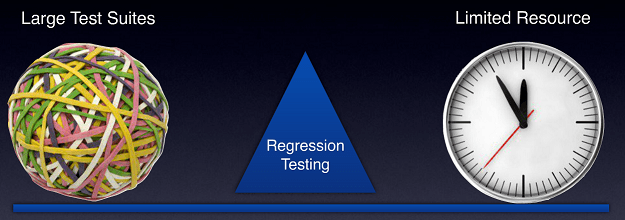
  • With successive regression runs, test suites become fairly large.  Due to time and budget constraints, the entire regression test suite cannot be executed
  • Minimizing test suite while achieving maximum test coverage remains a challenge
  • Determination of frequency of Regression Tests , i.e., after every modification  or every build update or after a bunch of bug fixes, is a challenge.
Conclusion:
An effective regression strategy, save organizations both time and money. As per one of the case study in banking domain,  regression saves upto 60% time in bug fixes(which would have been caught by regression tests) and 40%  in money.                               

Tuesday, 9 February 2016

What is Agile model – advantages, disadvantages and when to use it?

Agile development model is also a type of Incremental model. Software is developed in incremental, rapid cycles. This results in small incremental releases with each release building on previous functionality. Each release is thoroughly tested to ensure software quality is maintained. It is used for time critical applications.  Extreme Programming (XP) is currently one of the most well known agile development life cycle model.

Agile model in Software testing

Advantages of Agile model:
  • Customer satisfaction by rapid, continuous delivery of useful software.
  • People and interactions are emphasized rather than process and tools. Customers, developers and testers constantly interact with each other.
  • Working software is delivered frequently (weeks rather than months).
  • Face-to-face conversation is the best form of communication.
  • Close, daily cooperation between business people and developers.
  • Continuous attention to technical excellence and good design.
  • Regular adaptation to changing circumstances.
  • Even late changes in requirements are welcomed
Disadvantages of Agile model:
  • In case of some software deliverables, especially the large ones, it is difficult to assess the effort required at the beginning of the software development life cycle.
  • There is lack of emphasis on necessary designing and documentation.
  • The project can easily get taken off track if the customer representative is not clear what final outcome that they want.
  • Only senior programmers are capable of taking the kind of decisions required during the development process. Hence it has no place for newbie programmers, unless combined with experienced resources.
When to use Agile model:
  • When new changes are needed to be implemented. The freedom agile gives to change is very important. New changes can be implemented at very little cost because of the frequency of new increments that are produced.
  • To implement a new feature the developers need to lose only the work of a few days, or even only hours, to roll back and implement it.
  • Unlike the waterfall model in agile model very limited planning is required to get started with the project. Agile assumes that the end users’ needs are ever changing in a dynamic business and IT world. Changes can be discussed and features can be newly effected or removed based on feedback. This effectively gives the customer the finished system they want or need.
  • Both system developers and stakeholders alike, find they also get more freedom of time and options than if the software was developed in a more rigid sequential way. Having options gives them the ability to leave important decisions until more or better data or even entire hosting programs are available; meaning the project can continue to move forward without fear of reaching a sudden standstill.

Web Services Tutorial

Web services are open standard (XML, SOAP, HTTP etc.) based Web applications that interact with other web applications for the purpose of exchanging data.
Web Services can convert your existing applications into Web-applications.
In this tutorial you will learn what exactly Web Services are and Why and How to use them.

Audience

This tutorial will be useful for all those readers inclined to learn the basics of web services and implement them in practice.

Prerequisites

This is an elementary tutorial that introduces the concepts of web services. It does not require the readers to have a prior knowledge of any technology in particular, however it would certainly make you comfortable if you have a basic understanding of XML, HTTP, TCP/IP concepts.

Why We Use Stubs And Drivers?

Stubs are dummy modules that are always distinguish as "called programs", or you can say that is handle in integration testing (top down approach), it used when sub programs are under construction.

Stubs are considered as the dummy modules that always simulate the low level modules.

Drivers are also considered as the form of dummy modules which are always distinguished as "calling programs”, that is handled in bottom up integration testing, it is only used when main programs are under construction.

Drivers are considered as the dummy modules that always simulate the high level modules.

Example of Stubs and Drivers is given below:-

For Example we have 3 modules login, home, and user module. Login module is ready and need to test it, but we call functions from home and user (which is not ready). To test at a selective module we write a short dummy piece of a code which simulates home and user, which will return values for Login, this piece of dummy code is always called Stubs and it is used in a top down integration.  

Considering the same Example above: If we have Home and User modules get ready and Login module is not ready, and we need to test Home and User modules Which return values from Login module, So to extract the values from Login module We write a Short Piece of Dummy code for login which returns value for home and user, So these pieces of code is always called Drivers and it is used in Bottom Up Integration

Conclusion:-
So it is fine from the above example that Stubs act “called” functions in top down integration. Drivers are “calling” Functions in bottom up integration.